350 (living as if everything matters)

You may have seen references to the number "350" in recent months, in connection with concerns about climate change.  I've seen many of my "tweeple" (twitter contacts) who are involved in green issues and the good food movement talking about it, and finally checked it out.  

And here's the deal:  In a few short days, an organization by the same name (number?) will coordinate an international day of action, with almost 4,000 events currently planned in more than 160 countries, all around the world.

So what's all this about?  Nothing less than our common future.

One of the measurements used in calculating global warming and climate change is how much carbon dioxide (CO2) is in the atmosphere.  Right now, scientists have determined that there are 387 parts per million of carbon dioxide in the atmosphere.  Doesn't seem like much, right?  Well, they also have determined that the amount of carbon dioxide that allows for the maintenance of a liveable planet for humanity is 350 parts per million.  (More explanation here.)

Right.  So we're currently OVER the sustainable level.   What does that mean?  Well, it means that our climate is changing, ice caps are melting, weather is getting wilder, and droughts and floods are affecting the lives of people all over the globe.  It's already happening, now.  This is key:  many of the projections that scientists were making a few years ago have been blown out of the water--now, scientists think that the Arctic ice will melt completely in the summertime in just a few years (2011-2015) rather than 85 years from now as was projected just a couple years ago...

So are we just doomed?  Thankfully, no.  But we have to get the concentration of carbon dioxide moving in the other direction, and we have to start now.  We need to stop these current changes from taking on a life of their own, and if we don't get the levels down, the climate will change too much for us to be able to reverse.

350 describes it this way:  

We're like the patient that goes to the doctor and learns he's overweight, or his cholesterol is too high. He doesn't die immediately—but until he changes his lifestyle and gets back down to the safe zone, he's at more risk for heart attack or stroke. The planet is in its danger zone because we've poured too much carbon into the atmosphere, and we're starting to see signs of real trouble: melting ice caps, rapidly spreading drought. We need to scramble back as quickly as we can to safety.

If someone wants to argue that the economic costs are too high, or they don't believe the science, I don't know what else to say except that this world is too precious to gamble with.  I don't want to roll the dice and hope that the projections are wrong, do you?  (This You Tube video by Gary Craven goes over the logic of our various choices pretty clearly.)

So, what can you do?  

  • For starters, you can get involved on October 24th, by attending or organizing an event near you (find one here, organize and register your own here).  The goal of these events is to bring attention to this issue, to raise awareness, and to pressure our politicians to act.  There's lots of info, ideas, organizing plans, and resources on the website.
  • If you want to make concrete changes to reduce your personal carbon impact, try out this carbon calculator and find ways to reduce your output.

  • Take a look at the example of "No Impact Man," a guy in Brooklyn, NY who decided to see what it took to lead a zero-emission life.  We don't all have to go that far, but we can take a few small steps and have a big impact--which is why he started the No Impact Project, providing concrete, doable actions that we can all take.  A movie about his experience just came out--learn more about it, here.

It's easy to get overwhelmed by the scale of the problems we face...but, then, what's the alternative?  Sitting back and just flipping the channel?

One of the first times I came to visit the farm, I caught sight of a sentence highlighted on their brochure, which spoke to me so deeply I could hardly think about anything else for weeks:

Let us live as if everything matters.

Because it does.

And that's the truth of it.  I think we know it deep inside when we let ourselves grasp the enormity of the situation.  We were entrusted with an amazing gift, this tiny, unique, bluegreen orb out there in the vastness of the universe, our only home...and how we live here matters. 

knowing, forgetting, and making change

As the fall season settles in, I'm finding myself with a little more time to read in the evenings.  I've got a few things on the bedside table, but the one that's occupying my thoughts most right now is a book by Elizabeth Kolbert called Field Notes from a Catastrophe: Man, Nature and Climate Change.  It's a journalistic account of what's happening to our planet, with first-hand reporting and interviews with residents and scientists around the globe, in the Arctic, in Holland, in Costa Rica, in Vermont...

I've just started the book, and I'll tell you, it's a challenging read. I had read a series of Kolbert's articles in the New Yorker, a few years ago, and they were shocking, actually.  I mean, we hear about global warming and climate change, and we have been experiencing increasingly unsettled weather in recent years. I've read about vanishing glaciers, and endangered polar bears.  But this knowledge hasn't really penetrated my visceral, immediate worldview.  Somehow, it's possible to know something--in this case, the vast dangers of global warming to our planetary ecosystem--but then to compartmentalize that knowledge away from everyday decisionmaking.  Kolbert's articles were shocking, they hit me hard, and I tried to share them with people ("You've got to read this!"), but soon thereafter, I forgot about them.

Our ability to forget such things, or compartmentalize them, is one of our real human weaknesses.  I smoked cigarettes for years.  I knew they were toxic, I knew they were lethal.  Yet I continued.  In the final year that I smoked, I would treat myself to a smoke after going to the gym, some kind of sick reward.  We humans are strange and complicated beings.

When we allow ourselves to fully integrate such scary knowledges--like the dangers of smoking, and the vulnerability of our planet--we can make real changes in our behavior.  But this is hard work, and perhaps why there is so much resistance to acting to slow down climate change.  (I'm referring here to change at the individual level, not the corporate/organizational/political level, which has another order of challenges...)

Personally, I'm working to integrate the knowledge that I've been gaining about eating meat: the tremendous strain placed on our environment from producing a meat-heavy diet, the miserable and fetid lives of animals that are raised in Concentrated Animal Feeding Operations (and the diseases that thrive unders such conditions), the difficulty in finding meat that is sustainably and humanely raised and slaughtered...

We can take smaller steps, like participating in Meatless Monday, a campaign to cut out meat one day a week in order to improve our health and reduce the stress on the environment.  We can make sure we understand the manifold connections between food production and climate change (watch Food, Inc, if you haven't already), and pass on what we know.  We can support local farmers, and get to know the people who produce our food (check out the USDA's new website, "Know Your Farmer" and find farmer's markets near you).  We can choose organic, pesticide-free and heirloom varieties of food, to diversify our food supply and reduce the number of toxins added to our food and to the earth.  And we can start, all of us, to grow a little of our own food.  (There's an app for that: "Botanical Interests" can help you start gardening with your iPhone; thanks Urban Gardens for the find!) 

There's so much more we can do--we can step away from plastics, carpool and buy fuel efficient cars, press our government to invest in public transportation, and compost our vegetable waste, just for starters...

But mostly I think we have to let ourselves deeply integrate the intellectual knowledge we already have, and let a global perspective shape our vision.  The scientific community is very concerned, as each year, new research is outpacing earlier projections.  The icecaps are melting faster than we thought, there are redoubling effects that were unforeseen, and each year we are breaking more and more funky weather records...(If you haven't seen An Inconvenient Truth, the movie explains why weather will get more and more extreme and unsettled, rather than simply getting hotter.) 

All the knowledge in the world, though, isn't going to change our behavior, until we see ourselves as part of, integrated into, the natural world, rather than separate from it.  We are each of us organic matter, part of the universe, connected through the air we breathe and water we drink.  These elements cycle through us and swirl around us.  What I do to the air and the water impacts that planetary swirl.  We are woven together, and we are creating our future, at every moment, with every breath.

(This post is in alliance with Blog Action Day, focused on Climate Change)

Garlic planting time

October brings cooler weather, and that means it's time to plant garlic.  We love the stuff, and use it in our cooking every day.  Which means we need to plant a lot of it!  

There are many varieties of garlic, broken down into two subspecies: hardneck and softneck.  Hardneck garlic has a stiff stalk that emerges out from the narrow tip of the bulb and becomes the tall green scallion-like plant above ground.  Some of the varieties we grow here are Music, Romanian Red, Polish Hardneck, and Georgian Crystal.  Hardneck garlic is a cook's delight, in that each bulb grows four to five large cloves, which are easy to separate from the stalk and quick to peel.

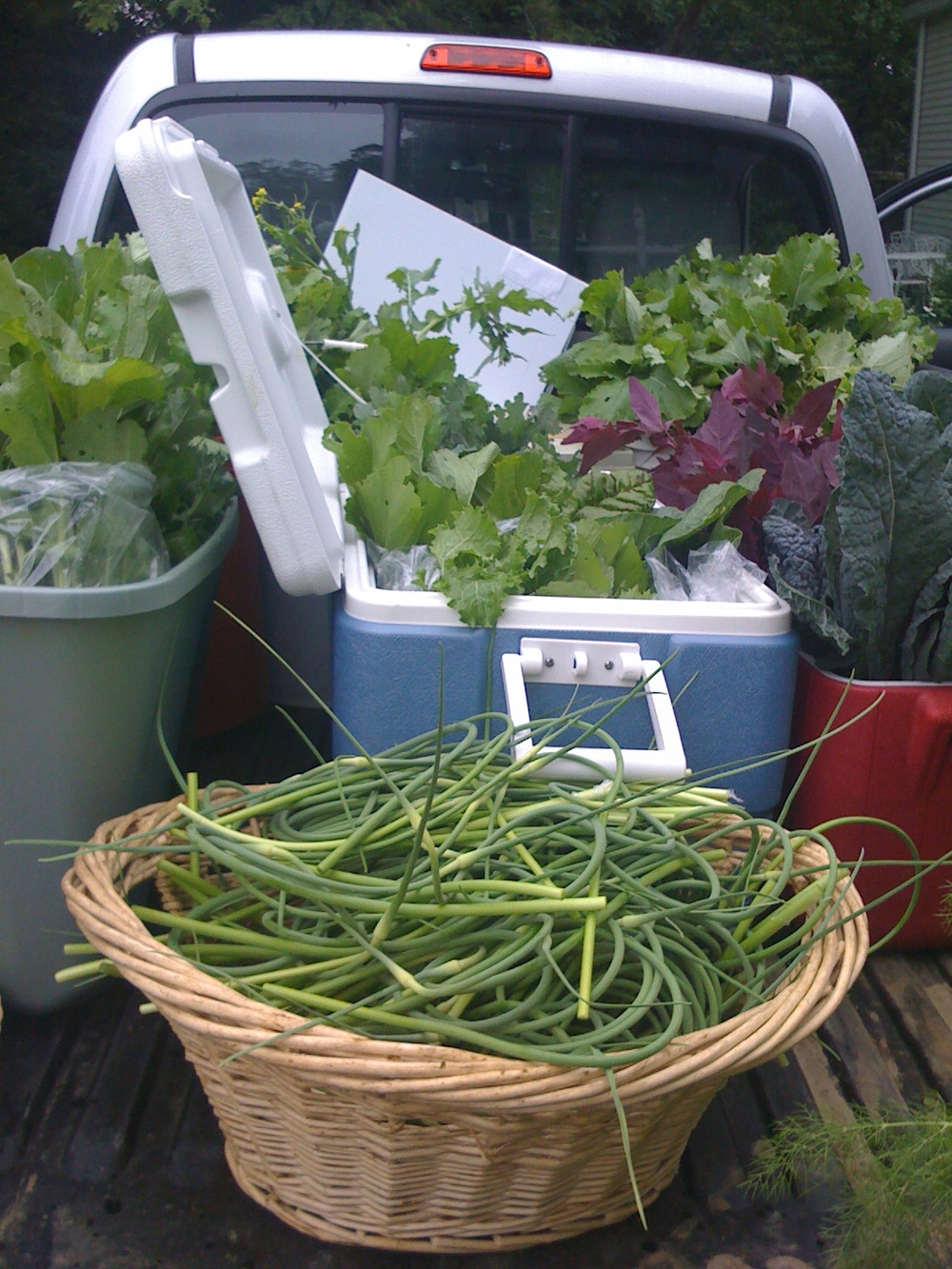
Scapes on the way to market, June 20Softneck garlic has, you guessed it, a softer stalk; these varieties of garlic have many small cloves covered by a silvery thin skin. (We grow Silverwhites and Inchelium Red.) Softnecks last longer in storage, and can be planted mechanically, two reasons why supermarkets carry that type almost exclusively. Hardnecks take a little more labor, as they have to planted by hand in a particular way, and their "scapes"--the curly green tops that appear only for a short while in spring, and that taste like garlicky scallions--have to be pulled by hand.  

And here's the genius of garlic:  you take a bulb of garlic, and break it into its cloves, let's say there are five.  Then you plant each of the five cloves in the ground, a few inches deep and six inches apart.  Next spring, you'll have five bulbs!  It's like magic.

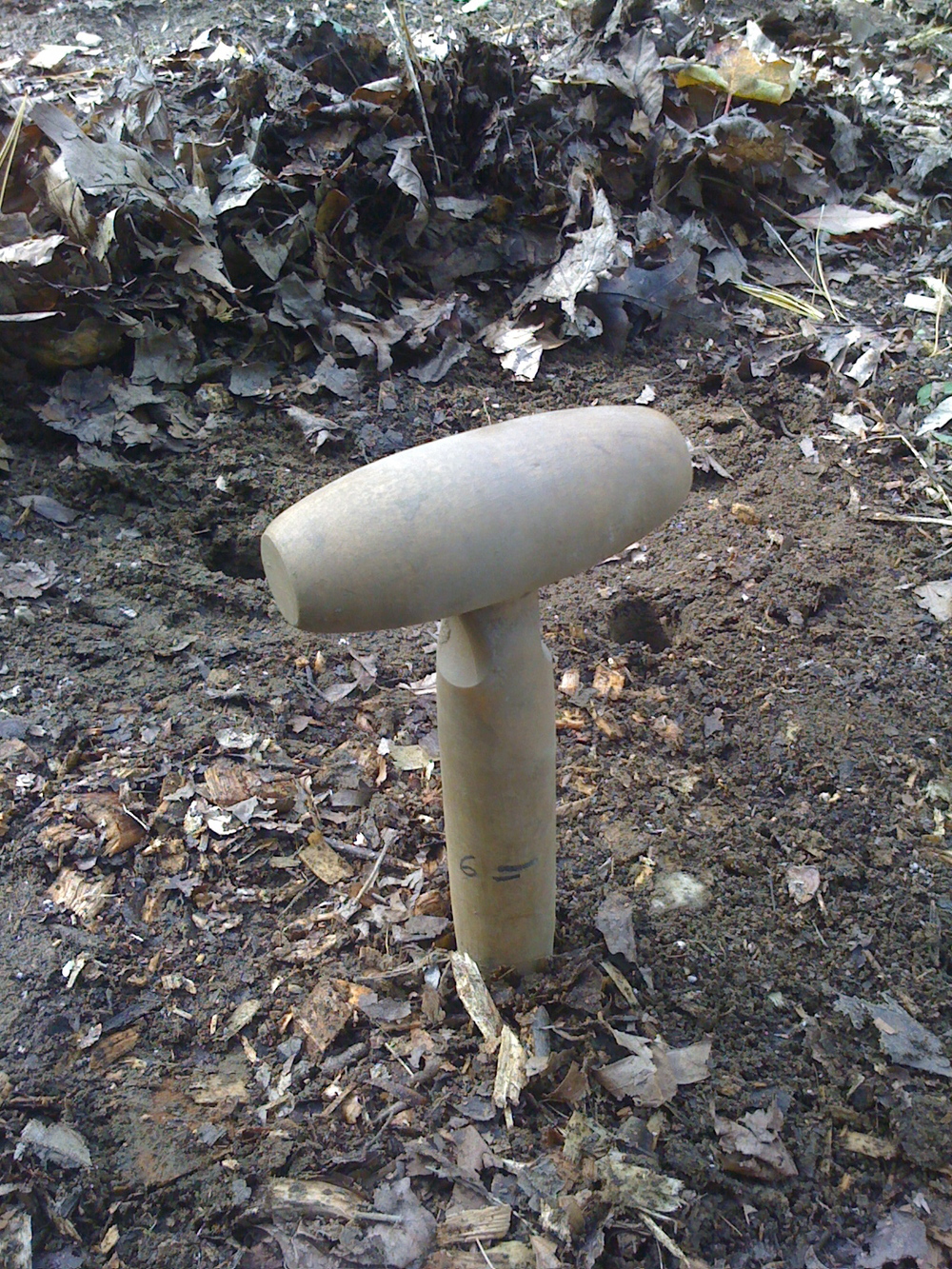
So, to plant hardneck garlic:  using some kind of implement, dig holes around four-five inches deep and about one-two inches wide; there's a tool for that called a dibble (the wooden tool in the picture to the left).  The holes should be about six inches apart.

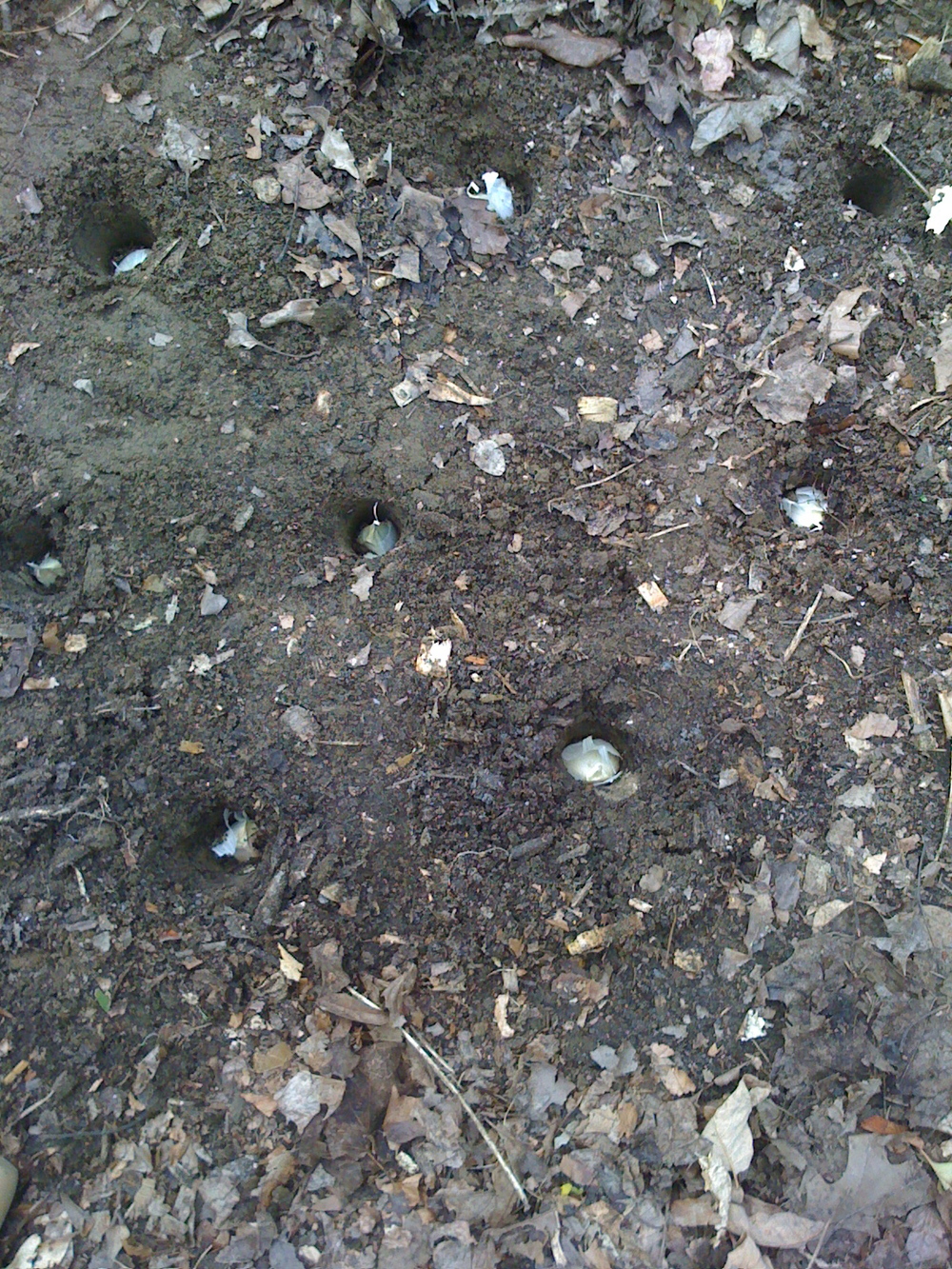
Eight little cloves, ready to sleep for the winterThen you simply place each clove, root end down, in one of the holes.  The pointed tip should be about 2 inches from the surface.  Finally, tuck the cloves in with some dirt and cover the whole area with mulch.

And then you just have to wait until spring.  

This year is the first year that the farm grew enough garlic both for seed and for our use (70 lbs!)--which is the key to farming, I think--taking care that we have sufficient stores for the winter, and making sure that we'll have a plentiful crop next spring.  I am learning to think in three timeframes, not simultaneously, but imagining back and forth in time to balance out the wishes of the present moment, the needs that may come in the deep winter, and the plans for next year's crops.  It's good mental exercise, and I find that I'm pretty sorely lacking in knowledge about how much food we'll need to get through the winter, and how many seeds we should plant or save for next season...The Sisters here are remarkably able to move forward without too much worry, there's no sense of hoarding, or incessant calculating, or spreadsheet madness.  I'm trying to put my own tendencies to plan and chart and count aside, and gently slip into the stream of faith that they so easily seem to swim in...

speeding by

Life on the farm is packed: early morning singing in chapel, caring for our animals, harvest and food preservation, noon chapel service, a community lunchtime meal, afternoon break and more work hours.  Then evening prayers and a light dinner.  The days and weeks just speed by...

But on Sunday afternoon, after our "house meeting" when the Sisters and other residents discuss and make decisions about farming projects, events, and day-to-day schedules, Anne and I stole away for an afternoon walk.  And I think I'll have to make a practice of it, because to stroll through the woods acquaints me with a whole other part of the farm, slows me down, and makes me appreciate this place even more.

The Community's property is about 23 acres, and we cultivate less than one acre (which makes our harvest, and the fact that we sustain ourselves primarily from our own crops, all the more impressive!).  Throughout the property there are about 300 maple trees, which the Sisters tap to make our own maple syrup. 

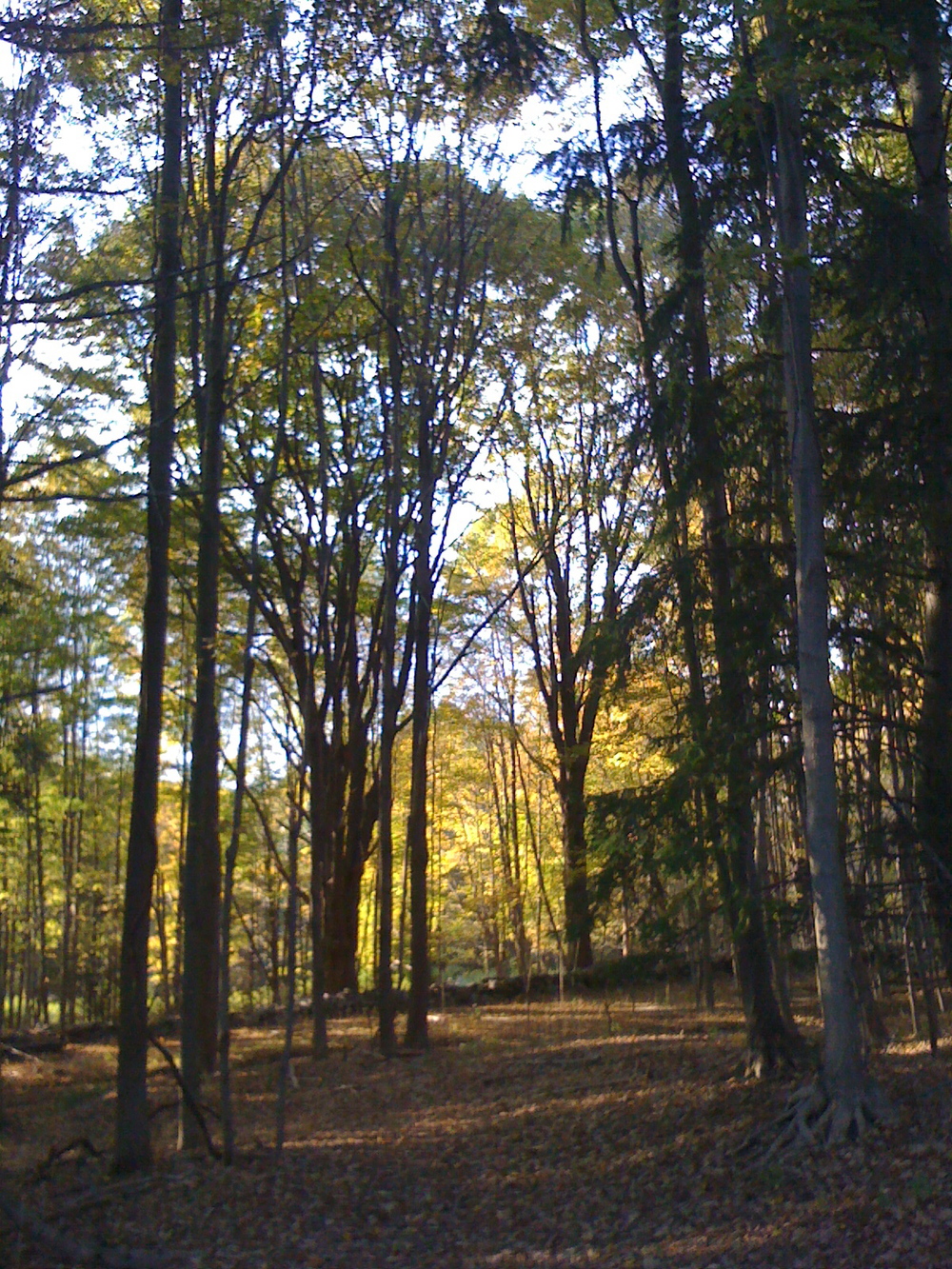
This photo is of an area that separates the farm and a playing field used by the Melrose School, a dayschool that shares the property. The ground is fairly bare, with few shrubs or mid-sized trees.  From what we've been learning about edible forest gardens, the forest would probably be healthier if it had a wider diversity of species to help protect and nourish the soil. 

A few years ago, one of the Sisters began planting fruit trees in the meadow below our main garden, which abuts this part of the forest.  We currently have at least two varieties of pear trees, apple trees, and a peach tree, as well as hazelnut trees in the nearby vineyard.  We're thinking about how to cultivate this lower meadow with a wide variety of fruit and nut trees and other edible plants.  If we can successfully "build into" this transitional space between the garden and the forest, we will be able to harvest many foods and materials without the intensive labor required by farming.

In this photo, Anne is looking down upon the playing field and the woods beyond.  It's such a serene place.  I can just imagine building a little strawbale house near this field, in the woods on the periphery...and the snowy silence down here in the wintertime.


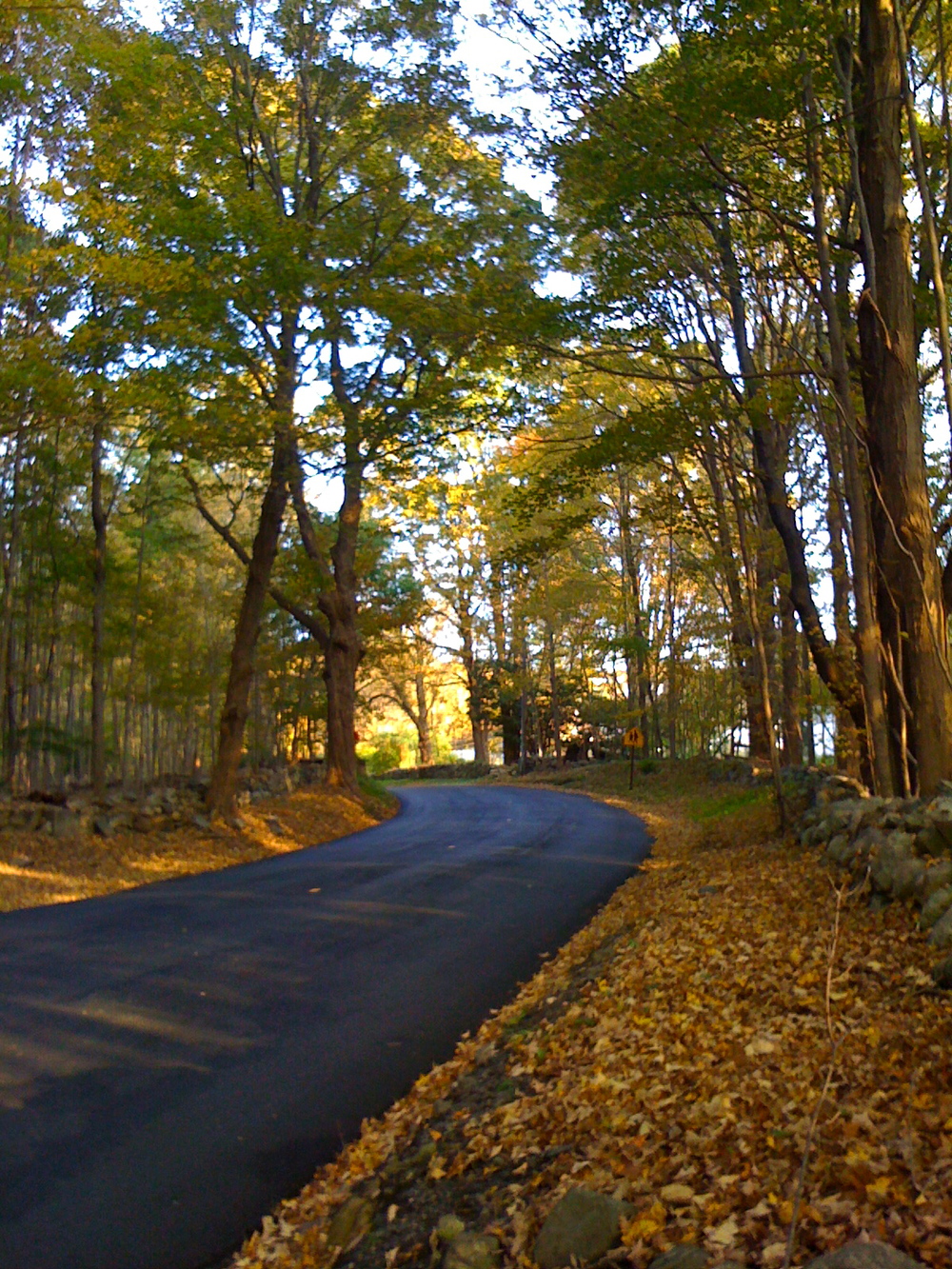
Walking back up to the farm, up the winding road that takes you to Farrington's Pond and then into Connecticut.  It's a bit of a shock when SUVs come barreling around this corner, rushing on their way, totally out of sync with the pace and peace of this area. Sans traffic, you hear the wind, the leaves falling, the chickens clucking, the sound of shovels hitting soil.  And then a big noisy car or truck will drive by, and you realize that we're living cheek-by-jowl with suburbia.  Or, really, that suburbia is speeding by us, oblivious to the quiet beauty and slower rhythm of this place.

I think that all those lovely manicured lawns that you can see on your way down the hill, when you get into town, would make great vegetable gardens.  Imagine if we were all growing a little bit of food, we could share seeds and tools, and have the pleasure of eating food we've planted and watched mature...imagine if we all were connecting with our neighbors around the activity of growing food.  Rather than spending big bucks on lawn care, and the costly and toxic pesticides that are part of that whole operation, we could use our yards for food.  This idea of "yard sharing" is becoming a reality, organized through new media--check out this site that connects people who have yards with people who want to garden.  

There's something about getting your hands in the dirt, about shuffling in the leaves on the forest path, about imagining new life in a plot of land that gets us to slow down, to see the way the light falls, to be creaturely.  I'm grateful for Sunday afternoons, and how they help catch me from just speeding by...

of shaggy manes and garden giants

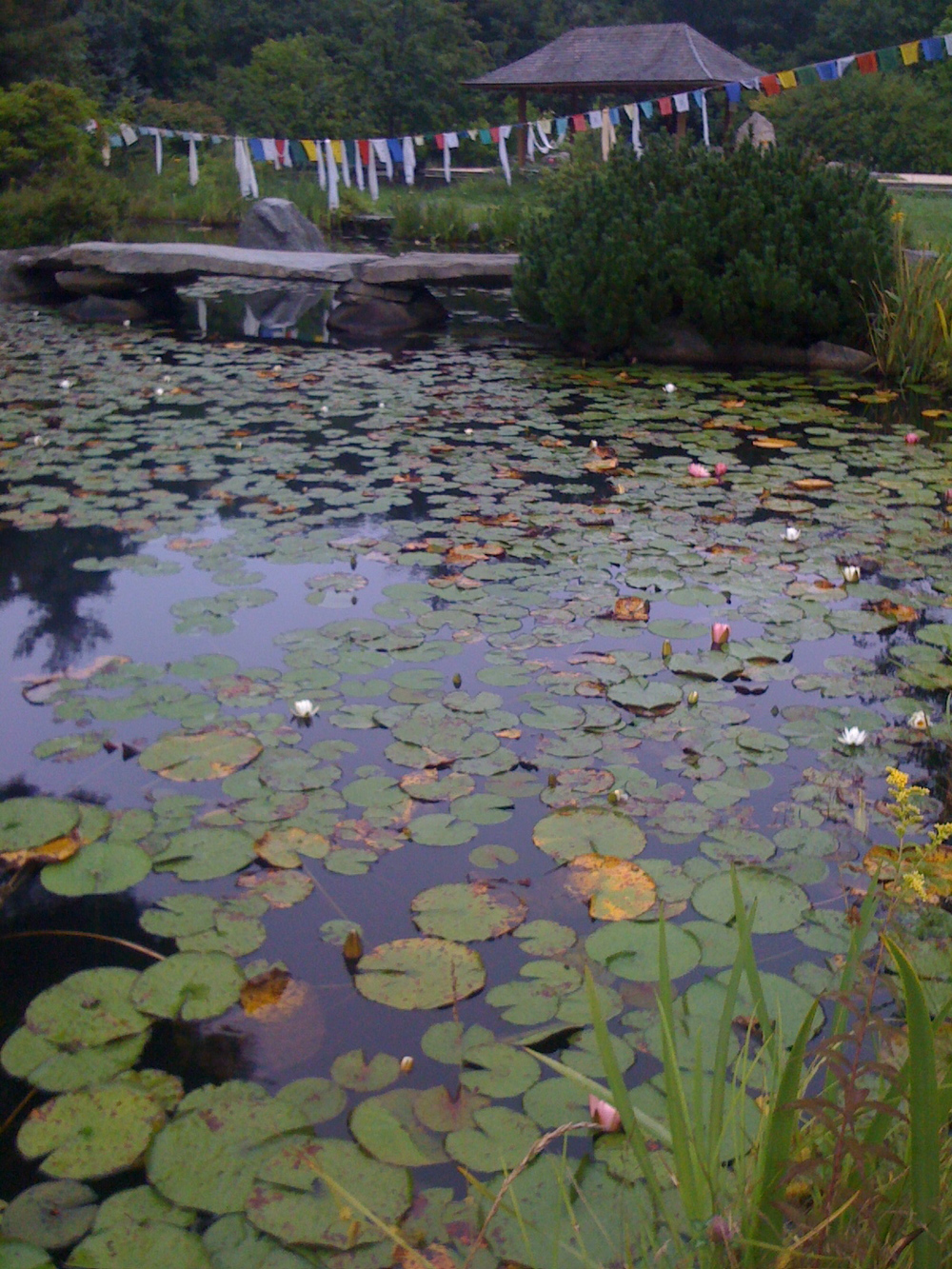
In August, I had the good fortune to be able to attend the NOFA (New England Organic Farming Association) conference in Amherst, MA.  It was a bit strange, going back to a place I had lived soon after college, when I worked for the Massachusetts Public Interest Research Group.  Back in 1994, I rented a big old farmhouse with Shannon and Kim, two friends and colleagues, and in the little spare time we had, we'd admire the fields surrounding the house or drive out to the Peace Pagoda, a Buddhist shrine dedicated to peace and non-proliferation.  It's a sacred spot, and one I knew the Sisters would enjoy, so after the NOFA conference we made a quick visit there.

Being back in Leverett, just north of Amherst, was a bit of a reawakening for me--or, perhaps better, a reminder that I have long loved wooded areas, big tall towering trees, and quiet spaces. Somehow I had forgotten these affinities of mine during my years in the city, and so it was striking to find myself back in western Massachusetts, and to realize that the farm where I now live is an awful lot like the farmhouse I lived in 15 years ago...that I've returned to an aspect of myself that has been dormant for a long time.

But that's not what I meant to write about tonight.  Mostly I just wanted to jot down a few words and post a few photos about mushrooms! But, wait!  Don't just think of the mushrooms you eat, for what's really mindblowing are mycelium, those delicate webby networks you sometimes see in the soil or in piles of decaying woodchips.  Mycelial networks are actually the more prevalent stage of mushrooms' existence, with miles of mycelium in the ground underneath your feet, digesting organic matter into the soil and making it more fertile.  What we think of as mushrooms are actually the "fruitings" of mycelium, happening only under certain conditions.  At the conference, we were enthralled by Paul Stamets, a big name in the field of mycology (see his talk on TED which is fascinating, esp. his work to combat pollution and disease through mycelium), and his presentations spurred us to integrate mycelium into our farming. 

We learned from Stamets that mycelium work together with (alongside or actually interwoven into) plant roots, channeling nutrients to plants.  If you can help encourage the flourishing of mycelium in your garden, you can help your plants become more robust and plentiful.  So one of the first things I did when I returned from NOFA was sit down to read his book Mycelium Running, and figure out how we could best incorporate mycology into our farming efforts.   In short, we decided to dust our seeds with mycelium spores before planting, and to start up a few mushroom patches that would get garden vegetable-friendly mycelium networks growing in our two biggest gardens.  We decided to do this in combination with rock dust and other soil amendments, in order to replenish the minerals and nutrients that have been depleted in our soil from decades of farming.  Happily, these two efforts are complementary, because mycelium break down larger mineral nutrients into smaller particles, making them available to plants.  We won't see the impact of these efforts for a year at least, since the rock dust takes time to break down and the mushroom patches take a year to fruit...but we are hopeful that these actions will help nourish the soil over time.

The mushroom patches are great because they not only help build better soil, but they also (eventually) provide you with food, so that's double the fun.  Anne and I created "beds" of various organic matter for the mycelium to feed upon, with a couple inch layer below and a couple more inches on top.  The "Garden Giant" mushroom apparently prefers woodchips, while the Garden Oyster snacks on straw.  And the Shaggy Mane is not too particular, but happy to be mixed in with compost or mulch or whatever you've got on hand.

Here's how we went about the process:

First we cleared an area about 4'x8' (this was a little larger, because I wanted to leave a border around the actual patch). Then, we "broadcast" (sprinkled around with wide movements of our arms) rock dust (in the white bucket) to increase the nutrient level of the soil, and then lay down woodchips on top of the whole patch.  It took three full wheelbarrows to lay down the first layer of woodchips.  You're basically making an edible home for the mycelium to devour, so that the bed can really flourish.  Once the bed is well established, you can take some of the woodchips and put them in other areas of the garden to get the mycelium running there, as well.


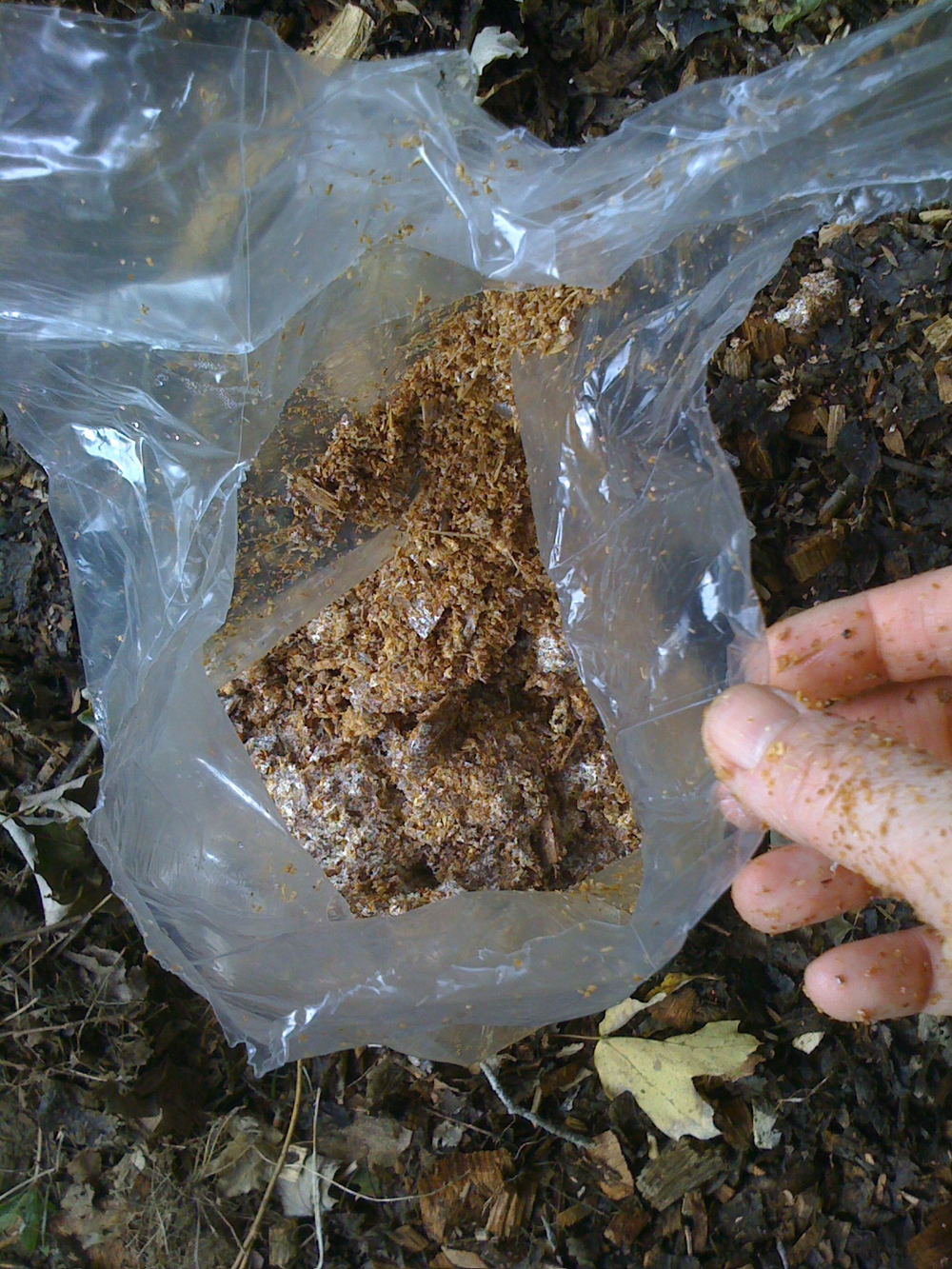
Then, we sprinkled the myceliated spawn that we had purchased from Stamet's organization, Fungi Perfecti, on top of the layer of woodchips.  What you see in the bag in this picture is sawdust and a few woodchips that have been "inoculated" with mycelium and allowed to begin developing mycelial networks.  Some of the handfuls I took out of this bag were nearly completely white as the mycelium had intensively colonized the wood; other handfuls were less developed and more granular. 


When all the spawn was put to bed, we covered them up with a nice thick layer of organic material.  In the case of the Garden Oyster mushrooms, we used straw, their preferred comestible. Here's a picture of Anne, distributing the last of the straw to tuck in the spawn in their new home, in and among the asparagus forest.  Asparagus is a spring vegetable, and when it goes to seed, it develops tall delicate fronds, which provided great shade for our farm cats, and now, hopefully, will be a good habitat for our new mushroom allies :)

So that's all for the mushrooms at this point, at least in terms of what we can do to help them along.  This is one of the aspects about farming that is a good practice for my life in general: learning to let go.  You do what you can, but at some point, you realize that it's no longer in your hands.  There's a whole host of variables outside your control, and maybe the best thing you can do is just bow your head to the soil and the microbes and the fungi and the worms, say a little prayer for them to all flourish, and then turn and head back to the barn or the hearth, to dream of mycelium running...