your feedback

One of the most wonderful things about writing this blog is the steady stream of emails, comments, and other feedback that I get from so many of you.  Writing a blog can be a lot like yelling into a chasm, and you can get to wondering if your words are just bouncing off the cliff walls, or if they're actually reaching people's ears.  So it's a joy to find that writing this blog has reconnected me with childhood friends and with colleagues I met along the way in academia, kept me close to friends and family who are far away, and strengthened connections with new folks in my life, who I've met since setting out on this food/farm/faith journey. 

Your words have affected me, not only by providing me that little boost of confidence, but also, more importantly, by collectively serving as a prism through which I can view myself.  Many of you have written to say that you're cheering me on, even following my adventures with a little envy, like my fellow Grad Center friend, who wrote: "Don't most of us secretly fantasize about leaving the hectic mundane for a more serene and simple life..."  I've been chewing on that sentiment for these last four months, since I began hearing it when I left my job.  It's held me to account, as I wonder: "Am I getting the most out of this experience, this privilege?  Am I working hard enough, learning enough fast enough?"  That's been a good dog, nipping at my heels.  

When I first began hearing this sentiment, back in July, my impulse was to urge everyone to quit their job, to find another way to make a living, to step out of the consumer culture.  Why should any of us be unhappy, unfulfilled?  And while I think that's true, at one level, the persistence of that sentiment has pushed me to reflect on my happiness level on a pretty regular basis.  Over the last few months, I've come to better understand that happiness is not achieved just with a change of job title.  I think that happiness is achieved when we act with intentionality, and when we are fully present in whatever we are doing; I know the happiest moments I've had here have been when I've paused and breathed and looked around, and realized: the world is shimmering with life, and I am part of that shimmering.  

I've written in earlier posts about how my worries about money have taken me out of that intentional, immediate space, and so I assure you, even in a more serene setting, it's possible to imagine yourself into stress.   And I've gotten stressed out by various gardening and cooking tasks, only to realize, later, that I was worried about how much, how fast, how long--that I was caught up in some strange internal race or competition.  In an important way, I think that the feedback I've gotten from so many of you has helped me realize that the city/country dichotomy is really just a kind of gauzy, imperfect shorthand for a deeper division: the split between appreciating the present moment and clawing/projecting at the future.  I can see now that a person could be joyous and intentional, no matter the location or circumstances.  That's the lessons of the mystics and prophets, right?  Although, I have to say that, for me, it's a bit easier to be in the present when my walk to work is about 30 yards, and there are four built-in opportunities for prayer and meditation each day.  Maybe I'll learn to be a mystic city dweller someday...

But for today, I'd like to ask you for your feedback about the development of this blog.  I would like to create a Guides to Yumminess (aka "recipes") section for this website, and would like your input.  What would you like to see there?  Are you looking for simple, easy dishes?  "Farm-to-table" ideas?  Vegetarian and vegan food?  Food-health connections?  Dinner-party ideas? Raw food?  Getting a better idea from you all will help me know how to focus my time in the coming months...

In addition, I'm going to write more posts about food and it's relation to our health and to the health of the environment.  There's a lot out there to cover, and I'm sure many of you are already familiar with some of the territory.  So I'd like to know, are there particular questions you have about "the good food revolution"?  Such as: Why some people argue that the label "organic" is not enough?  What's the deal with raw milk, pastured butter, and kefir? How to know which fish to buy? What's the problem with industrial agriculture?

Let me know what you'd like to see, both in terms of recipes and food/health posts--send me your ideas by writing them in the comments section just below, or by email.  Looking forward to hearing from you!
gratitudes


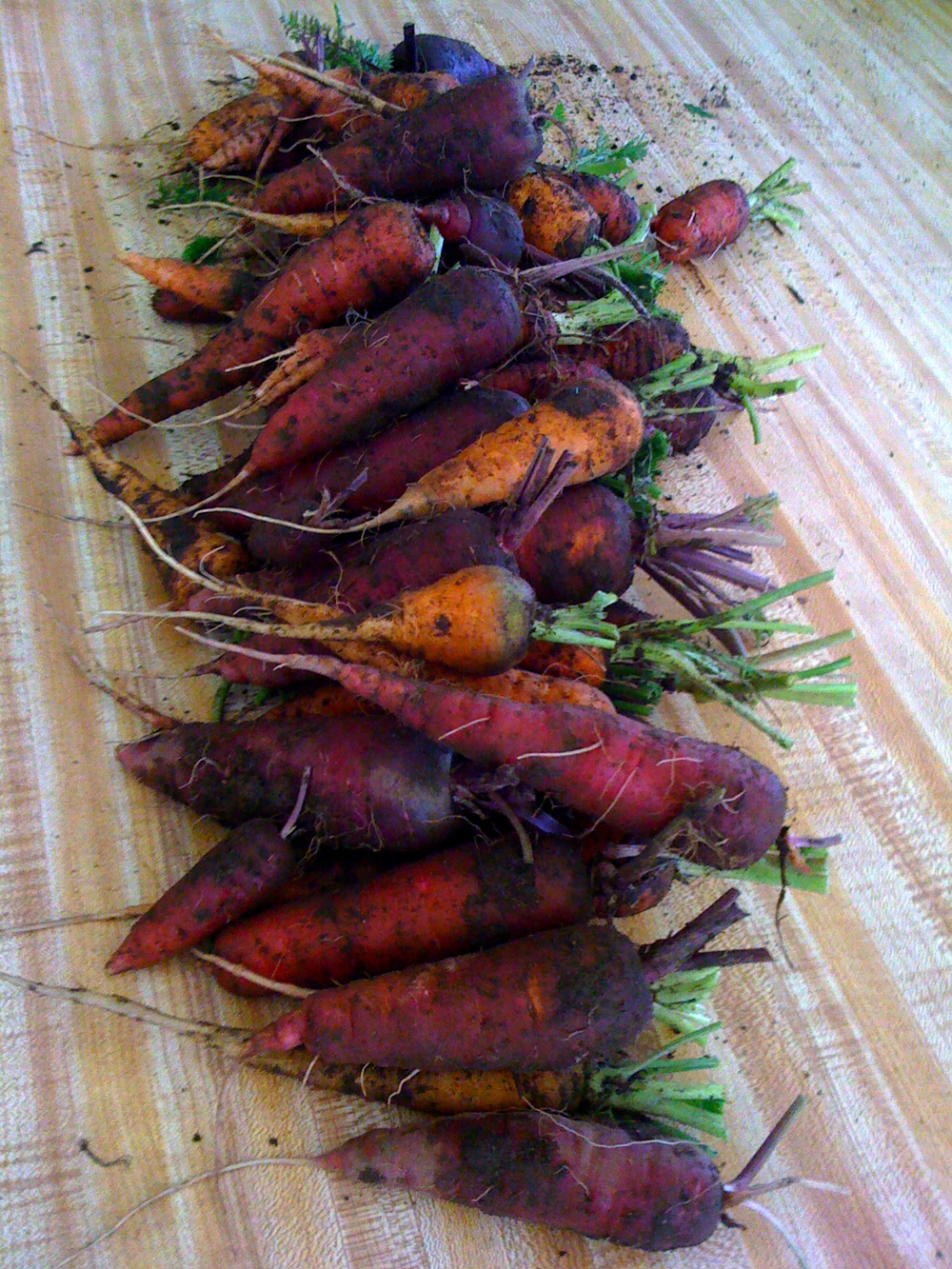
atomic red and cosmic purple carrots

A few of my friends have been writing daily "gratitudes" on Facebook, in the weeks leading up to Thanksgiving, and it's been a happy frequent reminder to notice and acknowledge all the good things in my life.  

Before our meals here at the convent, we join hands and people say something that they feel grateful for.  When everyone who feels like speaking has done so, we together say the following:  "For these and all your many blessings, we give you thanks, creator God. Amen."  

It's been a wonderful practice for me, to take a moment to reflect on the good, rather than just rushing from one thing to another.

I have so much to be thankful for, but it's unbearably easy to get grumpy and forget about those things.  Engaging in thanks-giving, every day, helps me to shake off the grouch, and realized how blessed I am.

Taking that moment pulls me out into a larger context, takes me out of the intensity or focus of whatever task I might be working on, out of whatever problem I'm trying to mentally unwind, and raises my eyes to look around me.  In that moment, I see the people, the land, the sky that surrounds me, and somehow this moment gives me the clarity to see what really matters.   

Here, in no particular order, are a few things I'm thankful for this season:

the amazing complexity and diversity of life

my growing understanding of the scope and mystery of the universe

my emergent spirituality

being exposed to new ideas 

the energy contained within a seed

food i can believe in

friends, both new and old

all the children and new babies in my life

fifteen years with Anne

President Obama and the grassroots activists that worked so hard to elect him

the smell of rich soil

being able to see the stars at night

those rare moments of meditation when i let go

all my family

Hope you all enjoy a wonderful Thanksgiving holiday, and that you experience many moments of gratitude in your everyday life, as well.

ebb and flow, garden-style

My first iMovie project: a chronological slideshow of the main garden here at Bluestone Farm.  You can watch the garden spring up, bloom, flourish, and then subside.  Reminds me of an ocean wave, the ebb and flow, but with moving at garden speed.

All the usual caveats: I'm just playing with photography, and I can see that there is much to learn.  These pictures were taken with an iPhone 3G, before the camera upgrade, so many of the pictures are blurry.  I plan on working with a better camera for subsequent efforts.  I came up with the idea for this project only in September, and could have created better continuity among the shots if I had envisioned this project back in March.  And I now see the value of keeping detailed records of where the shot is taken, what time of day, and other situational information; it would be a cool project to create a similar slideshow as if it was timelapse photography, with each shot taken from the same precise spot, at the same time of day.

Caveats completed. I hope you enjoy the show, and that it gives you a taste of the beauty I've been privileged to behold these last eight months.

Bluestone Farm, Eight Glorious Months from erin martineau on Vimeo.


thinning, in order to grow

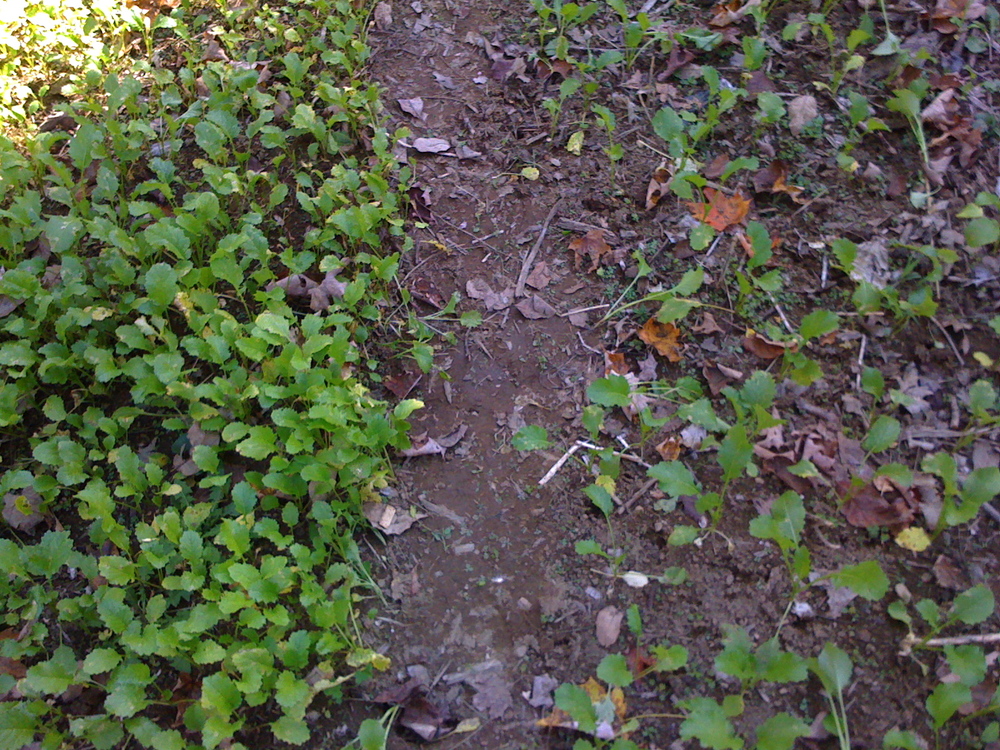
There’s a technique in gardening called “thinning.”  If new baby plants are coming in close together, you pull out a few of the plants in order for the others to flourish.  In one of our gardens, a broccoli raab plant had gone to seed in late summer, and dropped hundreds of seeds in an area about 7’x10’.  Hundreds of baby plants came up, and I spent one morning removing some of them and leaving the strongest, healthiest looking in the ground, with about 4” of space between each.  Thinning plants gives you some tender greens to eat while the plants mature, and allows for the remaining plants to make the most of the available nutrients in the soil.  I wasn’t able to finish the whole patch that morning, and when I went back recently the difference was striking: where I had thinned, each of the plants was sturdy and a strong green, while the others that were still packed in close together fared less well.  Some were pale, withered or stunted, others had brown spots.  That patch of soil simply couldn’t nourish all of those plants…they needed attentive tending, pruning, thinning.

broccoli raab plants

I’ve been thinking about thinning in relation to my own growth lately, what it is I’m removing, what it is I’m trying to help flourish. 

There were clear choices to be made when I prepared to leave a stable job, to depart from a recognizable career path.  Anne and I knew our financial situation was going to change, and that we would need to discern what really mattered to us, and what didn’t.  In some ways, the economic crisis that became apparent in September 2008 helped me begin preparing to make these changes, as I began to take stock, go frugal, and begin saving in earnest.  Buying non-processed food, cooking almost all our meals, curtailing our shopping, repairing instead of replacing, getting rid of cable…all of these helped me get clearer on how I wanted to live, what I valued.  Those were some easy plants to thin.

And since I began coming to the farm in March, and more intensely since I moved here in August, I’ve been occupied with doing another kind of  “thinning.”  It’s like I entered a kind of natural New York Public Library, with stores of knowledge available to me, and I’ve been winnowing through the possibilities and picking out a few stacks, at least to begin with.  I now see that there’s many ways to be involved with the “good food revolution” as Will Allen calls it: food policy, food activism, food-related public education, food distribution, commercial production, community-supported agriculture, and “homesteading” (small farms, to feed family and neighbors, possibly with some farmer’s market activity).  For me, I think my heart is drawn to the idea of homesteading, which is basically what we’re doing here at Bluestone Farm.  We grow our own food, from corn and oats to honey and eggs, from bok choi and kale to kidney beans and celery.  Herbs and spices, roots and greens.  We save our seeds and tap our own maple trees, make our own hominy and our own yogurt.  And the Sisters are learning to weave scarves and cloth towels, with visions of weaving their own simple clothes.

I still entertain the idea of diving deeply into a specialty, perhaps medicinal herbs, or mushroom cultivation, but I’ve always been kind of a generalist and I’m strongly interested in systems. I am pretty clear now, based on what I’ve learned so far, that I’m most drawn to learning how to grow a wide variety of vegetables, how to preserve and store foods, and how to plan a diverse garden throughout a whole year’s cycle.  I’m also interested in learning which plants flourish together, and which insects and flowers work in harmony with a vegetable garden.  And what I really value is being off the grid, being healthy, feeding and cooking for my friends and family, having a spiritual practice, and making a simple living. 

Those kinds of thinning have been pretty easy, I see now.  Although life here is pretty packed, there is time to meditate and pray every day, and in that spaciousness I have come to perceive that there’s more thinning to be done.  A kind of gnarled psychic understory, complete with dead branches and thorns, is in competition with all these new young plants I’ve been cultivating.  I think I naively believed that I could just press the “restart” button on my life when I came to the farm, and that the rhythms and the rituals here would shape me into the person I want to be, the person I know I am (somewhere deep down!).  I easily managed to bring only a few small bags of clothing, and a handful of books.  Turns out I just as easily brought a bunch of less useful baggage as well: insecurities, fearfulness, embarrassment, cynicism, doubt. 

I saw this all too clearly just recently, and the abrupt recognition of this old baggage actually caused me to laugh out loud.  The last few months, I’d been spending a good portion of my free time exploring various finance-tracking software.  I tried a bunch: Mint, Moneywell, Quicken, Moneydance, various Excel spreadsheets, and more…  I began the project with the notion that, in addition to monitoring our new budget, if I had a better idea of how we spent our money I could see if we could save even more.  All well and good.  But somehow that question got twisted up with various attachments and fears…See, I had saved up a bunch of money before I left my job, in order to be able to pay my not-insubstantial student loan payments every month.  I put that money in an account, and thought that these funds would provide me with some security, some freedom to really explore what I want to do in the world, to find my new path.  But somehow that money just seemed to loom larger in my mind, until it was nearly yelling: “what will you do when I’m gone!”  Because I am trying not to live out of fear, I kept just pushing that thought away.  And then going to the computer and playing with financial software.  I was getting more and more frustrated, as no one software seemed to do all the things I wanted it to do: track every expenditure, update automatically, show all the balances, create detailed budgets and reports…I spent hours manually categorizing various expenditures, correcting items, trying to convert a csv file to a qif file…on and on…None was meeting my needs, I was getting more and more frustrated, getting stressed out…losing sleep. 

And then it hit me.  I was trying to find a perfect software that would somehow alleviate my fears about the future, about how I would pay next year’s student loans.  And no software was ever going to do that.  I had more money in my savings account than I’d had in years, and yet I was stressing about how I was going to pay bills a year from now.  When was there ever going to be enough?  Was I worrying about money just out of habit?  I saw, in an instant, that my anxiety about money is related to a larger, deeper lack of belief in abundance, and that no amount of accounting can dispel that fear.  And then I just started laughing at the ridiculousness of it all. How many hours did I spend, trying to fill in a hole with bubbles?  Driven by doubts, I push so, so hard to arrange the world, toiling in vain attempts to ensure that things will turn out ok.  I’ve got to learn new ways of being in the world, of having faith and trust that good things will come.  So here I am, working to clear out this old, old, old brush, to find the stillness within, to cultivate the good soil, and to flourish.  Keep those garden gloves nearby, I may ask for your help.


breathing in this vivid world

I often feel like such a newbie here at the farm, having so little experience with growing things...  I think this is why I enjoy my time in the kitchen so much, as it's one place where I can bring a little skill.  This week I made a wonderful beet soup, and a gratin made from Osaka purple mustard greens (the gratin was a modification of this recipe).  I can't take too much credit, though: it's pretty hard to ruin a dish here, given the quality of the ingredients!~


Gingery beet soup
Roast a bunch of beets (scrubbed, trimmed, and then in the oven at 375 for 1.5 hours in light coating of olive oil, salt and pepper). When beets are done: In the bottom of a soup pot, sautee two big onions (chopped), and when they've sweated a bit, add a little garlic and two tablespoons of grated ginger.  Add a quart of soup stock, and then add the beets.  Bring to a boil and then remove from heat.  Let sit for 1/2 hour.  Then puree; to serve, add a dollop of sour cream or yogurt.  Delicious!!


But back to being a newbie:  A friend came to visit me at the farm this past week, and after I showed her around the gardens, and explained the tasks we're currently occupied with, she asked if I had gardened much before moving here. The answer is no: I'd pretty much had zero experience gardening.  She remarked that it seemed kind of overwhelming, and I realized that during our walk I had been spouting off all these little bits of information that I've learned: the names of different varieties, how to plant or tend certain vegetables, how to put the garden to bed.  Hearing her reaction, at the end of the tour, I first felt happy to realize how much I've learned in the last six months, but, then, I worried that I was presenting gardening in a way that was alienating, rather than inviting and accessible to anyone.  

It's true that farming engages with a great quantity of information--practical, scientific, historical, experiential.  But I do think that we all can grow food, and that we can learn a little bit at a time.  I'm lucky to be here with people who've been learning through direct experience (and reference books) for the last five years, and so I can learn from them, as I go.  I can talk about many of our crops here, but have direct experience only with a few of them: I've really only planted onions, celery, garlic, and beans.  I listen and ask a lot of questions, and I take comfort in the fact that I can look up information on the internet, if I need to remember how many inches apart something should be planted.  In fact, I carry my iPhone with me at all times, and refer to it in all sorts of situations...Such as: can you store apples and onions together in the barn?  No, apples give off a gas as they ripen which will hasten the aging of other vegetables...Or: how much mulch should you apply around the base of a tree?  Ideally, for young trees, all the way to the drip line (as far out as the branches stretch), but not up along the trunk of the tree, because that can rot the bark at the bottom of the tree...And so on, and so on.  

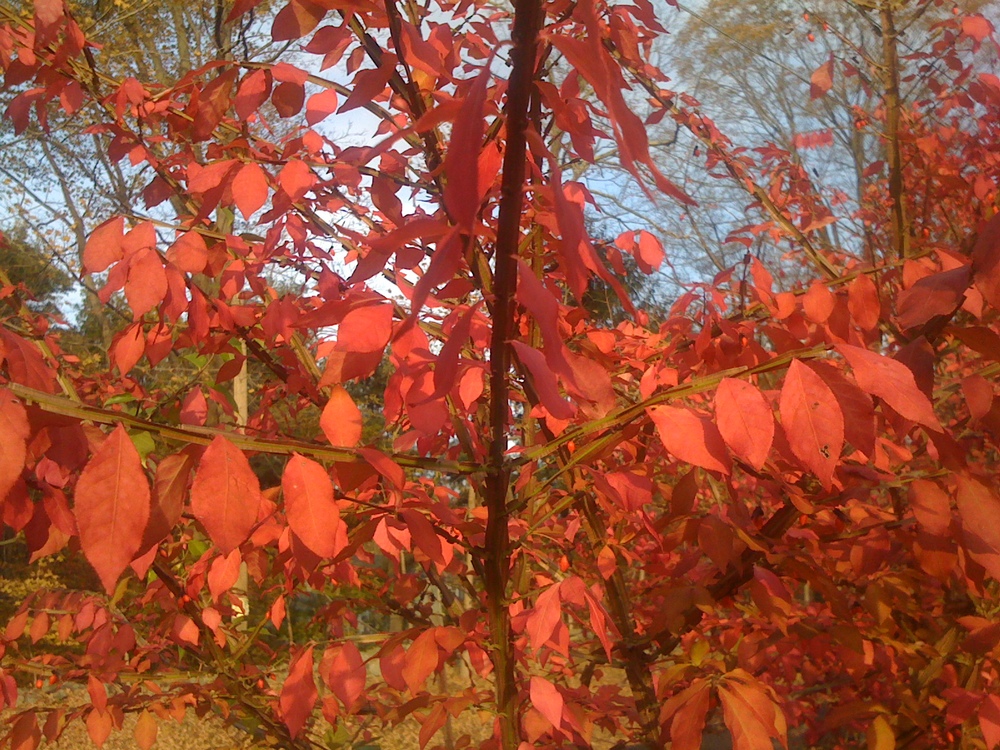
So, I've been feeling pretty secure knowing that I can look up information that I don't readily remember or know off the top of my head.  But then, when I went to start writing this post, I spent about half an hour trying to figure out the correct spelling for a tree that's common around here, and my guesses were so, so, so unbelievably wrong!  And my newbie-ness just became plain as day once again.  (I had heard people refer to the tree, saying something like "wingawanamus"...and after much searching I finally found the species they were talking about, the Winged Euonymus tree.  LOL!).  This tree turns amazing magenta, pink, and fucshia colors in the fall.

Winged Euonymus, in fall

It's amazing how much I don't know.  It's humbling, exciting, frustrating....  I'm humbled by it, realizing that I could continue farming for the rest of my life and always have more to learn. There's the basic information about plants--the qualities of the different varieties, what they need and who they like to live near. About how to plant:  where, how far apart, what time of year, under what conditions.  Then there's information about soil health, mineral composition, soil amendments, manure, mulch...  And then there's the whole world of biology, how plants actually grow, what kind of beings are alive in the soil, what they do and what they need, the process of photosynthesis...And the list goes on and on.  But the truth is that I could grow lots of things with just a basic level of information.  Although there is tons to know, you don't actually have to know a lot to start.

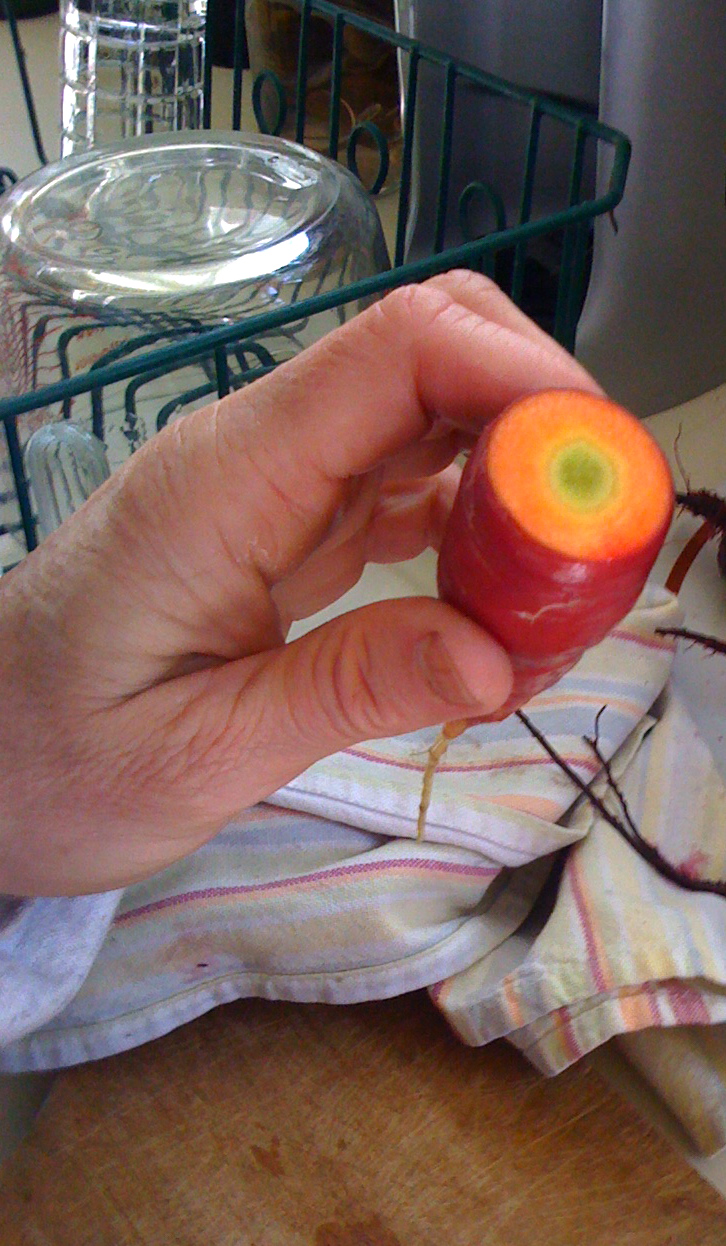
And it's entirely exciting, at the same time.  I feel like a little kid sometimes, exclaiming, "Look at that!"  I mean, who knew that brussel sprouts grew under the stems of leaves, in the "armpits"? That carrots can be four or five different colors, all in the same vegetable?  Atomic Red carrotWho knew that asparagus stalks, when left alone, can grow four feet tall, with delicate fronds and small berry-like seeds?  Who knew that you can harvest a few leaves at a time from a kale plant, and have that plant feed you for months and months?  I am astonished by the beauty and the design of the natural world, and my appreciation just grows and grows...

And I realize, glimpsing how little I know, that I'm also a little frustrated...I wish I had more time every day to read all the books on my nightstand, to sit down and talk at length with the Sisters here about their experiences farming, to go to local and national conferences about farming and the good food movement, to explain to everyone I know about what I'm learning about the production and politics of food and the implications for our health, our economy, our environment, our world...

So I go to bed each night, amazed and a little dazed at how little I know.  It's a good feeling, when all's said and done.  While it can be overwhelming to be such a newbie--and not just in terms of farming, as I'm simultaneously a newbie at living in community, at spiritual practices, at believing in abundance, at integrating scientific knowledge into my worldview (I mean, have you seen Carl Sagan's series, "Cosmos"?  Holy Moley!!)--I'm also thankful to be so inspired, to be experiencing so much joy in learning, to realize that as I'm turning 39 this year, I am breathing oh so deeply in this vivid world.  The colors, beauty, scope and scale astound me. There is so much to learn.