Monday
Oct222012

Thinking about planting, climate change, and resiliency

We just built a couple of cold frames this past week, which is what we will use until we can afford to build a greenhouse.  Cold frames are handy for starting little plants, keeping them protected and warm in the early spring months.  I can also pull the window frames up and out from the wooden frames, and plant lettuces and kale directly in the ground, letting them grow all through the season, and well into the winter.  If only I had made these over the summer . . . we could have a nice batch of greens in there right now.

The cold frames are part of a longer term plan to get our little homestead a bit more prepared to face the vagaries of climate change.  As much as possible, we are trying to create a place where we can be resilient in the face of power outages, extreme temperatures, massive precipitation, and drought.  Yesterday's hurricane didn't cause much damage in our immediate area, and for that we are very grateful.  But if we are going to experience, as Andrew Cuomo said to the President, "a one hundred-year flood every two years," there's no reason to think that we won't have another extreme weather event this fall, never mind whatever comes next year.  Last year, in western Massachusetts, we had a tornado in June, Hurricane Irene in August, followed four days later by a tropical storm that dropped four inches of rain in 24 hours on already oversaturated ground.  And then, of course, there was the 18" of snow we got right before Halloween.  So I'm trying to get it into my head that these are not one-time, or rare events.  These are periodic, and random, and I want to be prepared.

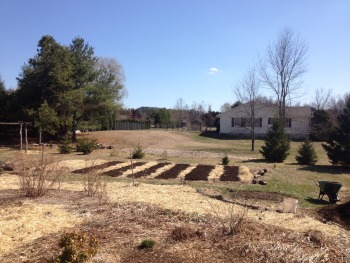
Among the things to consider:  Water, in floods and droughts.  In addition to buying rain barrels to hook up to our gutters, to allow us to capture rainwater whenever we can, I'm also going to be building up the soil's capacity to store water. This spring I'm going to dig shallow trenches a couple feet wide within the gardens, pile up old wood in the trenches, and then re-cover them with soil; when wood is decomposing underground, it acts like a sponge, able to absorb excess water and to release it in times of drought.  This technique is called "hugelkultur" (a German word).  We don't want to have to put a strain on our well in times of drought, so building up organic matter in the soil is key to storing water.  I also want to slow the flow of water down the slight slope of our land, so that when it does rain, the water can be absorbed into the soil, rather than just running off the surface, into the road, and into the nearby stream.  In order to slow the water, I am going to create swales and berms, or small hills and valleys, along the contour of the slope.  Imagine water running down a slope, then meeting up with a small trough right before a hill that extends 6 feet wide or more.  The water will pool here, get absorbed somewhat, and excess will flow around the hill and continue down the slope, only to encounter another hill.  Our greatest slope is located where our fruit trees are planted, so I am going to create berms on the downward-slope side of each row of trees.  You can see a picture of this technique here.

There's so much to do--build a greenhouse/hoophouse to protect plants from hail and keep them warm, plant a range of perennial fruits and vegetables that thrive in extremes as well as "normal" temps, figure out a way to heat our home during a power outage (we've got a pellet stove, which is dependent on electricity), build a root cellar to store food during the winter, switch to solar-powered electric and hot water, get a composting toilet . . . It's a bit overwhelming, and events like Hurricane Sandy make it clear that the faster we can implement these changes, the better.

I know that some people consider it unseemly to talk about politics in the midst of natural disasters, but, at least to me, politics and climate change events aren't separate things.  On the one hand, we have a political party, the GOP, that takes great joy in mocking efforts to address climate change (when they are not outright denying it even exists), and that has stated a desire to defund FEMA and leave rescue and relief efforts to private business and the states.  And on the other hand, we have a Democratic Party that has finally, finally, finally started to forcefully articulate the notion of the shared public responsibility we have to one another, the fact that we are a society not just a collection of individuals, that we are all in this together, and that we need each other--and public servants like firefighters and police and FEMA--in times of crisis.  Now FEMA and government programs are not perfect.  But their ability to marshal resources and coordinate efforts on a national level is unparalleled. Government has an important role to play in facilitating our common good--our public treasury, our infrastructure, our education, our disaster relief, our safety nets, our safety and security.  So the question, as related to climate change and disaster relief, is this:  Who do you want in charge--the people who believe in smart, effective government, or the people who think government should be so small you could "drown it in a bathtub"?  There are people across the country right now who need disaster assistance, and I am so very glad that FEMA hasn't been dismantled.  And if we are ever, ever going to do anything about climate change, it will have to happen on a national level, and with the international community.  It's not something we can just leave to localities and states. We've got to do what we can for ourselves, but we've also got to work together for the common good.

Tuesday
Oct092012

shifting winds, always a new adventure

It's truly difficult for me to believe that the month of October has arrived.

Before paintingAfter painting!Getting settled in our new home, painting, tending the vegetables, and building out the new garden beds for next season . . . it's been a whirlwind. I like nesting, and I'll admit that it's been a bit hard sometimes to pull myself away from the decorating and organizing of our home back out to the weeds. But every time I get outside, I remember why I love farming . . .

Staking young tomato plantsSheet mulching creates new garden bedsWe planted about 20 pepper plants, 12 tomato plants, and 8 eggplants, and a smattering of basils, Holy and otherwise. I was so grateful that we got such a good crop--though we had to chase away the chipmunks from the tomatoes, without much success. Still we harvested many, many pounds of delicious vegetables, ate them fresh, grilled 'em up, and preserved them for the winter.

We loved hanging out at the town lake

and the back deckFriends and family from near and far (CT, NY, DC, VA, FL and Amsterdam!) visited, making our new house a home. We went to the town beach, hung out on the back deck, even went all the way to Essex for gluten-free fried clams. What a treat! Go to Woodman's, people, if you've never been. Absolutely worth it.

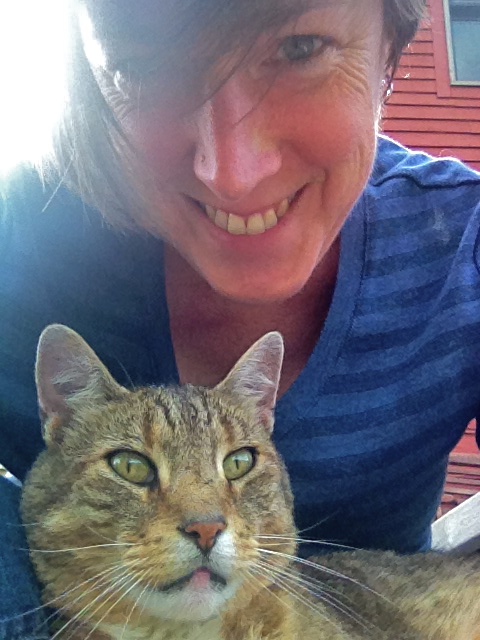
they don't stay small long . . . We got chicks, who grew into chickens. Really fast. They "graduated" from their brooder to the outside coop just last week, after they had reached six weeks of age. It took a night or two of shining the flashlight in their roost, but they eventually got the idea, and now put themselves to bed right at dusk. And we adopted a lovely mouser named Jasper, who's bringing me presents of dead mice on a regular basis. The thing is, it actually makes me really happy. I'm hoping he'll be a force against the chipmunks, voles, and moles that have laid claim to this place. And chase away the rabbits, too.

Grateful for a bountiful harvestI canned salsa and diced tomatoes, roasted and skinned and froze poblano and anaheim peppers, cooked up and froze great big batches of bangan bharta (curried eggplant and tomatoes) and creamed chipotle kale, and picked quarts of raspberries to freeze alongside the peaches from our local orchard. We're drying apple slices in the dehydrator as I write.

And I've been playing around with pork, cooking up a scrumptious meal of slow-cooked pork jowls on top of homemade nixtamalized corn tortillas. Probably one of my best meals ever. And I made headcheese. You take a pig's head and simmer it for a few hours, then remove all the meat and put into a little terrine. Then you simmer the stock another couple of hours; let it cool a bit, and pour a small amount of liquid over the meat, just to cover. Refrigerate. The stock turns to gelatin, and, voila, headcheese. Delish. Plenty of adventures here at . . . well, we still don't have a name for this place yet. (Suggestions welcome!)

It's been a busy four months! But now the winds are shifting, the temperatures are dropping, and I'm feeling a pull back here, to this blog. Someone told me in the last few years that we shouldn't think of ourselves having a "crazy, busy life" but, rather, a "full" life. I like that. Life certainly is full, and I am so grateful to be able to experience so much beauty and laughter, even with so much sweat and so many tears. As I exclaimed to my friend Eileen, trying to explain my aching love for the world, "We get to experience all this . . . and tomatoes, too!"

And now there is yet another a new adventure. I'm starting a proofreading business, called "Another Pair of Eyes," to help financially support the farm. I'd like to build good fencing, a small barn, and a greenhouse, and all that takes capital. I've decided that the best way I can do that is to rely on my strengths in writing and editing, and offer out my services as a proofreader. The homepage for this website is now dedicated to my new business, instead of the blog, which now can be found among the menu options on the right of the page. Take a look!

I hope you'll remember me if you ever have a document you'd like to have proofread, and I hope you will suggest my services to your friends and colleagues. Thanks for your support and for spreading the word!

Tuesday
Jul032012

surfaces

One of the myriad choices we were confronted with upon buying our house was how to refinish the floors. They hadn't been done in a long, long time, and had become gray and worn in the high-traffic areas and a bit orangey-yellowed in the far corners. The home inspector recommended refinishing them to prolong the life of the floors, not simply for cosmetic reasons, which made sense. It also made sense to refinish them before moving in, since it's easier to do when the house is empty of furniture (and residents!).

The conventional path is to use polyurethane to finish floors, which basically creates a plastic coating on top of the wood. Due to the VOCs emitted (volatile organic compounds), this means you are breathing in toxins. Polyurethane coatings get scratched and dulled, and the only way to deal with that wearing is to sand the whole floor and re-coat it. After doing some reading and thinking about this, I began looking into alternative floor finishes. My goals were multiple--to avoid the toxicity, to avoid the environmental pollution resulting from disposing the waste, to be economical and spend as little money as possible, and to be able to maintain the floor finish over time. Turns out that polyurethane is a relatively new process, only in use for about the last half-century. Before that, people used oils, like linseed oil, to seal floors and protect them from water damage. The oil penetrates the wood and protects it.

But when I looked online to learn about oil finishes, it seemed daunting. Few people seemed to be in the business of doing oil finishes, first of all. But I realized if I could do it myself, I could cut costs, perhaps. Some protocols called for using a buffing machine, which I don't have and which I might be intimidated by, at least at first. Some methods took many days, because you need to wait awhile in between applications--I was impatient, and wanted to be living in our new house as soon as possible!

Finally, I spoke with my friends Sam and Leslie, who built a house that was designed in an environmentally conscious way. They used a product that they applied themselves, and that they were really happy with--an oil-based finish out of Germany, by a company called Osmo. I began reading about this product, and realized that it looked like it would meet all my criteria. It's very eco-friendly, and any scratches can be spot treated--which means that I should never have to sand the floor again. It's easy enough to apply, so I could refinish the floors myself.

Osmo Polyx Oil is applied by scrubbing the oil into raw wood or a newly sanded floor. It's a workout! You use a stiff-bristled brush and scrub the oil into the floor in a small area, until there is no excess left behind. Then you move to the next area and repeat. It took me about four hours to apply the first coat to an area of about 600 square feet. The odor was not too bad, but I wore a respirator to be safe. I slept in the house with the windows open that night, and then applied the second coat the next day. It was safe to walk around in socks after the second coat dried; we waited to put down any furniture for 10 days, and we waited three weeks before putting down a rug.

The floors have only gotten more and more beautiful over the last four weeks. At first, they were a little shiny, but as the Osmo oil kept working its way into the wood and curing in the air, the floors began just to look like natural wood. I love to see and feel the grain under my fingertips when I touch the floor, and it feels great under foot, too.

In the end, splitting the job by hiring a person to sand the floor and applying the Osmo myself cost about the same amount as hiring someone to sand and polyurethane the floor. But I hope that the cost over the next few decades will be much less, as we will be able to touch up any scratches, and should never have to sand or refinish the floor in its entirety again. And it definitely gives me a feeling of pride and accomplishment to have done the oiling myself. You can't put a price tag on that.

But I have to admit to being a bit overprotective of the floors. We now have a no-shoes policy for the house, and each bit of furniture has felt pads where it makes contact with the floor. I sweep frequently, hoping to get up all those tiny little sharp-edged rocks and prevent them from disfiguring the new, beautiful surface. I suppose I'll relax a bit, eventually. But being this up-tight makes me feel kind of bourgeois. Am I really that concerned with appearances? Didn't I give up my subscripton to Dwell, didn't I stop lusting after modern design when I decided to start farming, when I remembered the moon and the stars and fell back in love with the natural world?

Somehow it was easy, when I first moved to the nuns' farm, to just turn away from my city life and start anew. I just brought a couple small bags of farm clothes and a couple books, and that was about it. But in the last year, I've been pulled to re-integrate my sense of design with my life on the farm. Maybe I don't go out to contemporary art museums, sip cocktails at fancy bars, or wear funky shoes anymore--but part of me still loves the aesthetics of those experiences and things. Maybe nowadays I wear dirty jeans for several days running, and put my hair in pigtails. Maybe a big night out nowadays means going to sit on the town common with an ice cream cone, and listening to a local band. But I still love the simple lines of the couch that Anne and I found eight years ago, and I'm happy every day when I see it in the living room. I love the modern Italian dining table that we bought, and the translucent orange chairs we chose to accompany it. I look at these things and I look at the workboots by the door, next to the mallet and trowel and twine, and wonder how they all fit together...

I suppose we are all more complex than we seem. I love modern design, and farming, and bad sci-fi, and local organic food, and hand-woven rugs from far-away places. I make choices within that matrix of affinities and desires, and endeavor to remain true to my heart and my values. It's actually been a little humbling to re-integrate my "city self" and my "farm self" these last six months or so. I realize that I had been feeling more than a little moral rectitude in turning away from consumerism, that I was feeling a bit superior in choosing a simpler life. Setting up our own place has meant making a lot of choices about things--keeping, discarding, buying things. It was easier, in many ways, living at other people's farms, making do and being satisfied with other people's stuff.

Now, in our own home, I'm thinking about surfaces, about appearances, about ecological choices, about priorities, about needs versus wants. Every purchase requires so much consideration. Is it necessary? Can I get it locally made, US made? Can I find it used, on Craigslist? Should I buy the more expensive, better made version, rather than something that will have to be thrown away in a few years? Will this particular thing help us save energy in the long run, even though it will cost more now?

And I'm thinking about wanting to make a welcoming home, one where people can feel at ease--while I'm also wanting to preserve the beauty of the newly finished floors. But if the house is going to be a home, if it's going to be a homestead, I'm going to have to let go. To appreciate the beautiful things, and to let them be lived on, and with. To let the surfaces reflect my deeper values, in addition to my aesthetics. To let the surfaces reflect a life well lived.

Sunday
Jul012012

Not farming

Just staring at the water...

Thursday
Jun282012

in the garden now...


This week brought us a chicken tractor.  I had grand plans to build one myself, but when I found one on Craigslist, I decided to earn my carpentry chops sometime later and just get one that's already been built and already been loved.  The person who sold it to us is a Landscape Architecture grad from UMass, who's done amazing things with his property.  He also does tree work, and I just might be calling on him later to help me trim back some of these evergreen trees...  Now that I'm ready with housing, I'm picking out chickens.  More on that to come.


We've bought a number of things from Craigslist recently--a rug, a table, a bird bath, and a chicken tractor.  In each case, it was a real pleasure to meet the folks selling the item, to learn a little bit about the history of the item, and to wish each other well in our respective paths.  It's been truly heart-warming.  Everyone has their story, their particular slice, and to get a glimpse in and have a moment of friendly connection with strangers is humbling.  We are all just trying to live a good life.  Well, almost all of us--you do need to watch out for the occasional scam--I put an item on Craigslist the other day, and one of the responses offered to pay me more than I asked and to send me a check, and to send me money to cover the movers' costs...it was a bit suspicious, so I did a little research and found that this gambit is a typical scam.  Someone sends you a (fake) check, often greater than the amount due, and then asks you to wire them back the overage.  The check turns out to be forged, you are responsible to your bank, and somehow they get into your bank account through the wire transfer.  I don't really know how it works.  So--if you are going to use Craigslist, just do your transactions in cash and in person, and you'll be all set. 


In other news--there are so many new flowers in bloom, and I'm truly at a loss.  We are lucky to have found this beautiful place, lucky to wake each morning to birds singing, to be able to enjoy the colors and fragrances of the many plants...and we are also a bit stymied!  We just don't know the names of so many of these flowers and plants, and would love to know.  So take a look at all the pictures I took the other day, and if you see one you know, leave a comment identifying it.  Let's do a little "crowdsourcing," open up the floodgates of the wisdom of the masses...


I do know this guy pretty well--the Black Seaman tomato.  All of the tomato plants have set fruit already, and I'm very excited to see them doing so well.  The garden they are in now is partly shady, so I didn't have high expectations.  But perhaps they will flourish and give us a few good bushels.  We can hope.


The peppers are a bit slower, but some of the plants are setting fruit. We should have a good crop of jalapenos, cayenne, and tangerines (sweet), at least.  And the first flowers are appearing on the eggplants.  Keep your fingers crossed...  We made delicious Bangan Bharta, an Indian dish made of eggplants and peppers, and froze quart-size bags of it.  There's only one bag left in the freezer, so I am hoping that we'll get a good crop and end up with brimming-full freezers once more.


But so much is out of our hands, like everything in life.  I feel like my heart could burst from the happiness and the hope, all rolled together, that I feel when I walk through the garden.  If everything thrives, if they continue to flourish the way they are right now, if all the plants don't get damaged or dessicated or devoured by critters...if, if, if...


It's like that logic statement.  If x, then y...  All I can say is from my experience from the last few years: if the harvest is good, we will celebrate, and if the harvest is meager, then we will cherish what we glean.  Last year, I lost most of the 250' row feet I planted of dry beans, and much of the 30 hills of dent corn I planted.  The plants grew so well, I was actually wondering how on earth I would ever shell the beans and corn at harvest-time.  Turns out I needn't have worried.  In the great rains that followed the hurricane last August, almost all of the beans moldered, hanging in pools of water that could not drain because the soil was so sodden.  I tried walking among the plants, to see if I could lift them out of the puddles, but my boots sank 6 or 8 inches into the muck.  The corn was fine, just inaccessible, and I figured I just had to wait a few days to retrieve it from the field.  I ended up having to wait more than two weeks before the soil dried out enough to venture back in. And in the meantime, the deer got in and gobbled up at least half of the corn.


But we did harvest some beans and some corn.  And we appreciate them all the more, I think, because of our intimate experience with their story.  I know what they went through and what I went through, and now they are in my hand, in my bowl, nourishing me all the same.  With the corn, I make masa for tortillas or tamale pie; the beans are a staple for Anne's lunches, packed in tiffins and brought to work. 


This year, we are only growing tomatoes, peppers and eggplants.  What's in the garden now will feed us and give us great pleasure, though we'll have to rely on the supermarket much more than in the last few years.  But I can see a larger garden emerging, just beyond the edging, right where that sod is now.  Next year, at this time, the lawn will be full of plants and flowers, and we will walk among them with hearts full of happiness and hope, wondering what the harvest will bring.